🚀Day 10/180 (Math) 190. Reverse Bits(Leetcode)
#180DaysOfDSA#DailyCodingChallenge #LeetCodeJourney #GeeksforGeeks #CodingNinjas #Codechef #CodeForces #ContinuousLearning #TechCommunity
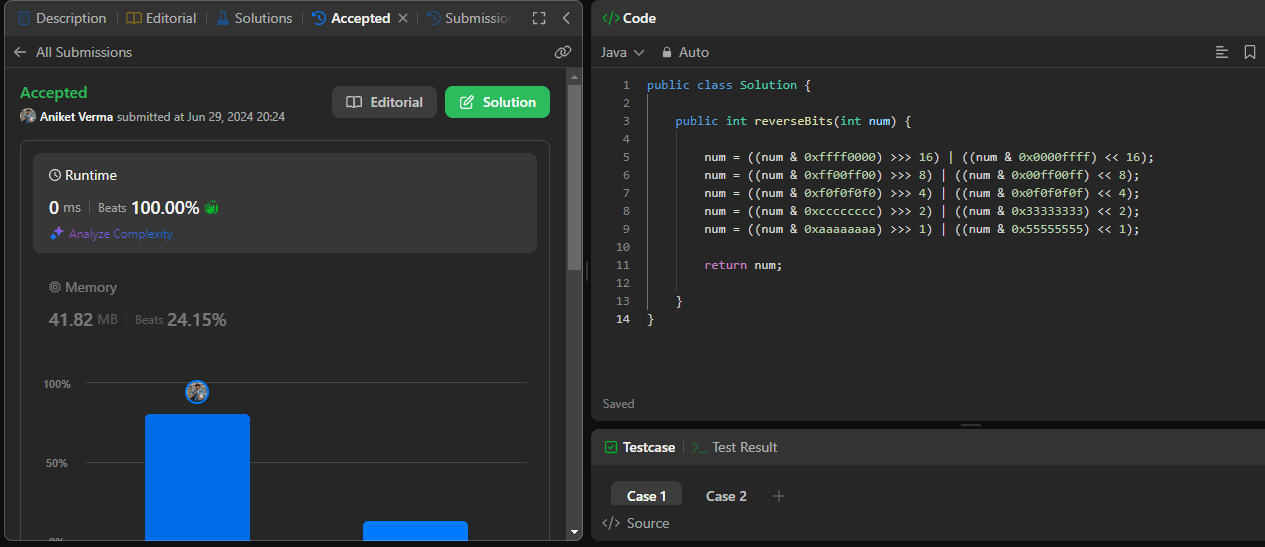
Code :
public class Solution {

    public int reverseBits(int num) {

        num = ((num & 0xffff0000) >>> 16) | ((num & 0x0000ffff) << 16);
        num = ((num & 0xff00ff00) >>> 8) | ((num & 0x00ff00ff) << 8);
        num = ((num & 0xf0f0f0f0) >>> 4) | ((num & 0x0f0f0f0f) << 4);
        num = ((num & 0xcccccccc) >>> 2) | ((num & 0x33333333) << 2);
        num = ((num & 0xaaaaaaaa) >>> 1) | ((num & 0x55555555) << 1);

        return num;

    }
}
Let's perform a dry run of the reverseBits function using an example integer.
Example Input:
Let's take num = 0b00000010100101000001111010011100 (which is 43261596 in decimal).
Step-by-Step Execution:
Initial value:
num = 0b00000010100101000001111010011100First operation:
num = ((num & 0xffff0000) >>> 16) | ((num & 0x0000ffff) << 16)Breaking it down:
(num & 0xffff0000) >>> 16isolates the higher 16 bits and shifts them right by 16 positions.(num & 0x0000ffff) << 16isolates the lower 16 bits and shifts them left by 16 positions. Result:
num = 0b00001111010011100000000000000010
Second operation:
num = ((num & 0xff00ff00) >>> 8) | ((num & 0x00ff00ff) << 8)Breaking it down:
(num & 0xff00ff00) >>> 8isolates 8-bit groups and shifts them right by 8 positions.(num & 0x00ff00ff) << 8isolates the remaining 8-bit groups and shifts them left by 8 positions. Result:
num = 0b10011100000000001111010000000010
Third operation:
num = ((num & 0xf0f0f0f0) >>> 4) | ((num & 0x0f0f0f0f) << 4)Breaking it down:
(num & 0xf0f0f0f0) >>> 4isolates 4-bit groups and shifts them right by 4 positions.(num & 0x0f0f0f0f) << 4isolates the remaining 4-bit groups and shifts them left by 4 positions. Result:
num = 0b11110000000000001011100000001010
Fourth operation:
num = ((num & 0xcccccccc) >>> 2) | ((num & 0x33333333) << 2)Breaking it down:
(num & 0xcccccccc) >>> 2isolates pairs of bits and shifts them right by 2 positions.(num & 0x33333333) << 2isolates the remaining pairs and shifts them left by 2 positions. Result:
num = 0b11000000000000001011000010101010
Fifth operation:
num = ((num & 0xaaaaaaaa) >>> 1) | ((num & 0x55555555) << 1)Breaking it down:
(num & 0xaaaaaaaa) >>> 1isolates individual bits and shifts them right by 1 position.(num & 0x55555555) << 1isolates the remaining individual bits and shifts them left by 1 position. Result:
num = 0b00111001011110000010100101000000
Final Output:
The function returns:
0b00111001011110000010100101000000
Which is 964176192 in decimal.
Summary:
Input:
0b00000010100101000001111010011100(43261596 in decimal)Output:
0b00111001011110000010100101000000(964176192 in decimal)